
The 2025 Index highlights key trends and concerns among young Australians regarding their digital lives, focusing on safety, technology use, access to devices, social media engagement, and online support seeking.
Fake news is a top concern
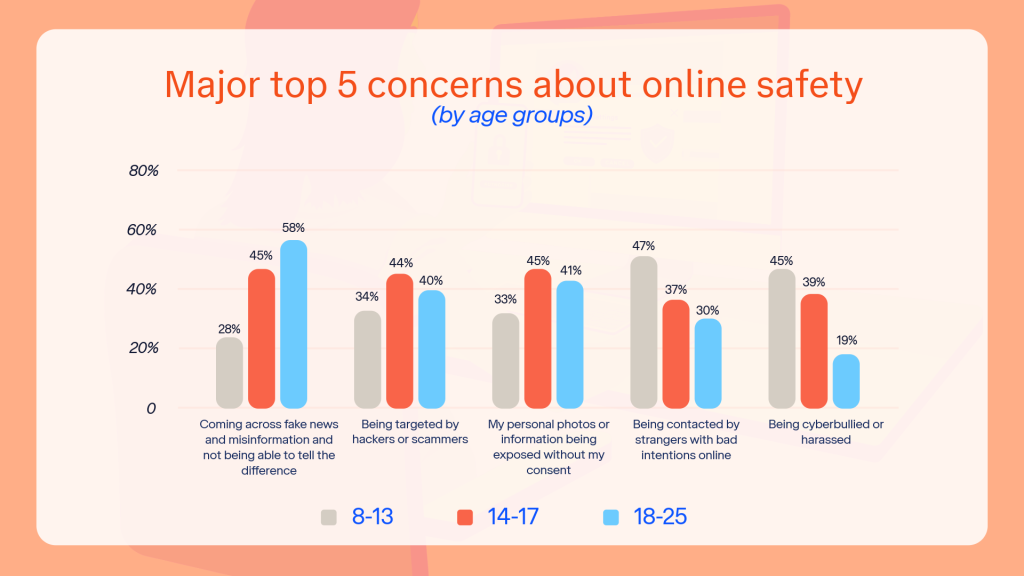
Fake news has moved into top spot, ahead of scams, in the list of safety concerns young people have around being online. Close to half (45%) said they were worried about coming across fake news and misinformation and not being able to tell the difference, while 39% said they were worried about hackers or scammers and the same percentage were worried about having photos or personal information exposed without consent. Young people show strong awareness of a range of safety risks but are still developing the skills to manage these risks.
Following this insight, we worked with Young & Resilient Research Centre to conduct workshops with children and young people to explore their perspectives about accessing trustworthy information and news online. The report on this additional research can be found here.
Young people have embraced artificial intelligence, but don’t always fact check accuracy
Young people have embraced artificial technology and are using it in innovative and creative ways, whether at school, work or home. Four in five young people aged 8 to 25 are now using AI, including 90% of those aged 14 and over. More than half (56%) say they find it easy to integrate AI tools into their everyday tasks (up from 45% in 2024).
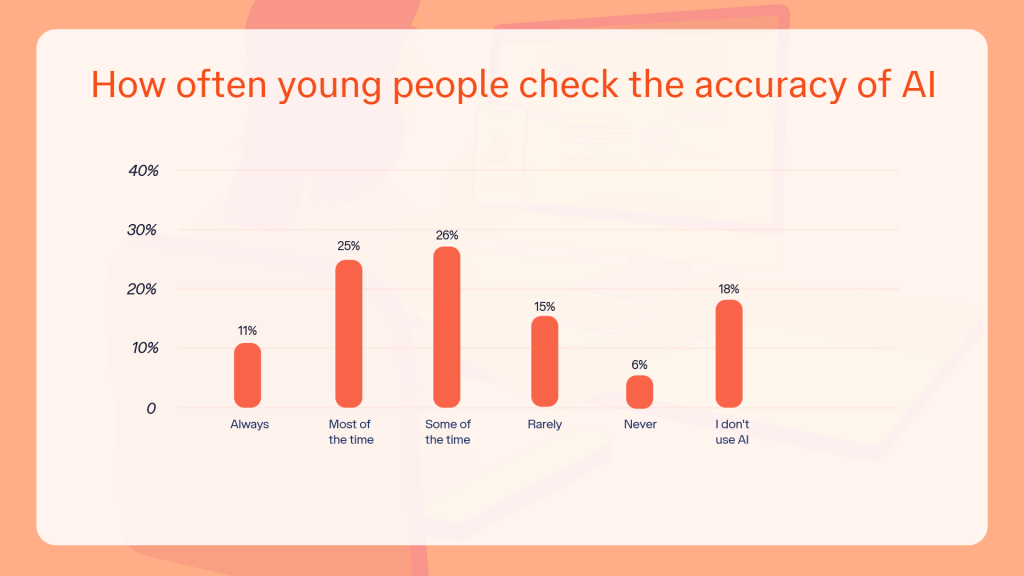
However, one in five young people said they “never” or “rarely” check the accuracy of information provided by AI, meaning many will accept AI “hallucinations” at face value, notwithstanding their concerns about fake news. This may in part reflect the level of confidence in fact-checking information – 58% said they found it easy to fact check information found online, the same percentage as last year. There is an opportunity, and a need, to support young people to develop their fact-checking skills and confidence in identifying and dealing with misleading and inaccurate content.
Access to Learning Devices remains an unsolved and growing problem
Access to learning devices remains a significant issue for some young Australians, with the digital divide appearing to widen in the last 12 months. The percentage of young people who have access to neither a laptop nor desktop at home has grown from 19% in 2024 to 23%, or 1.42 million young people, in 2025. This includes 523,000 aged 14 and above, for whom access becomes essential for learning and daily tasks.
People with no access to learning devices were also:
- Less likely to have home WiFi
- Less likely to be able to use the internet to complete all tasks needed
- Less likely to have a quiet place to work
- Likely to have more difficulty with a range of online tasks
- Likely to have greater online safety concerns but a lower awareness of how to stay safe
- More likely to be impacted by cost of living issues
More likely to live in regional/remote Australia than cities.
Nearly all young people are using social media, and will need support adjusting to age-based controls
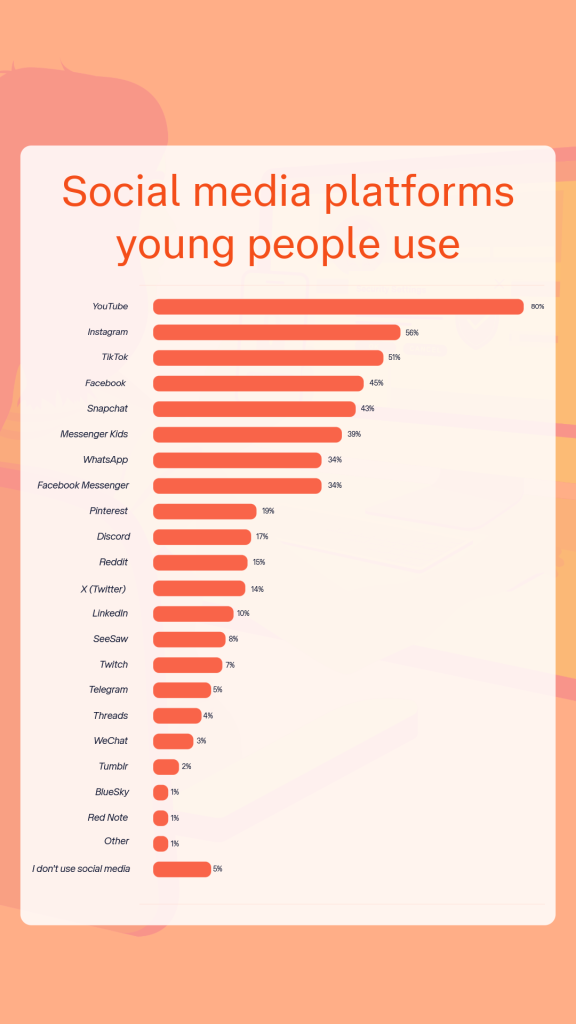
Social media is deeply embedded in young people’s daily lives and leisure time. Even the youngest group are heavily using apps such as YouTube, Messenger Kids and TikTok. Only one in twenty young people aged 8-25 (5%) reported having no access to social media in this year’s Australian Youth Digital Index.
Young people use these apps in a variety of ways, exploring their creativity, staying in touch with friends, and following causes and subjects they are passionate about. Around 60% said being online helped them stay in touch with friends or connect with others like them, 42% said it helped them feel like they belonged to a community and 47% said it gave them opportunities for creative self-expression.
While young people can see positive and negative elements about their time online, including when on social media, more young people say social media has a positive impact on their lives than a negative one.
This year’s Index coincides with the start of new restrictions on social media use for under-16s. Given the widespread use by young people, we will need to support younger users to adjust to life without .
More young people are accessing support online for topics such as relationships, sex, body fitness and how to make things with tech
Young people are comfortable using the internet to seek support and find answers to a range of issues they face in their daily lives. The internet offers immediacy, anonymity and objectivity; in-person support, on the other hand, may be more personalised, emotionally supportive and relationship-based. We ask young people where they would turn first for advice, gaining insights into how online help-seeking is changing.
An increasing number of young people prefer to go online for information on safe sex and consent, their body and fitness, and relationships with friends, narrowing the gap to in-person support which remains the more popular information source for each of these. The internet is the first port of call for 64% of young people when learning to create with technology (compared with 28% in-person support), and is also the preferred information source for health/sickness issues (51% vs 34% in person) and job searches (51% vs 39% in person).